What Most Brands Get Wrong About Custom Boxes With Logo
The custom boxes with logo hidden costs, printing methods, and supplier secrets most brands don’t know about can quietly turn a smart packaging investment into a budget nightmare — and it happens more often than you’d think.
Here’s a quick summary of what you need to know:
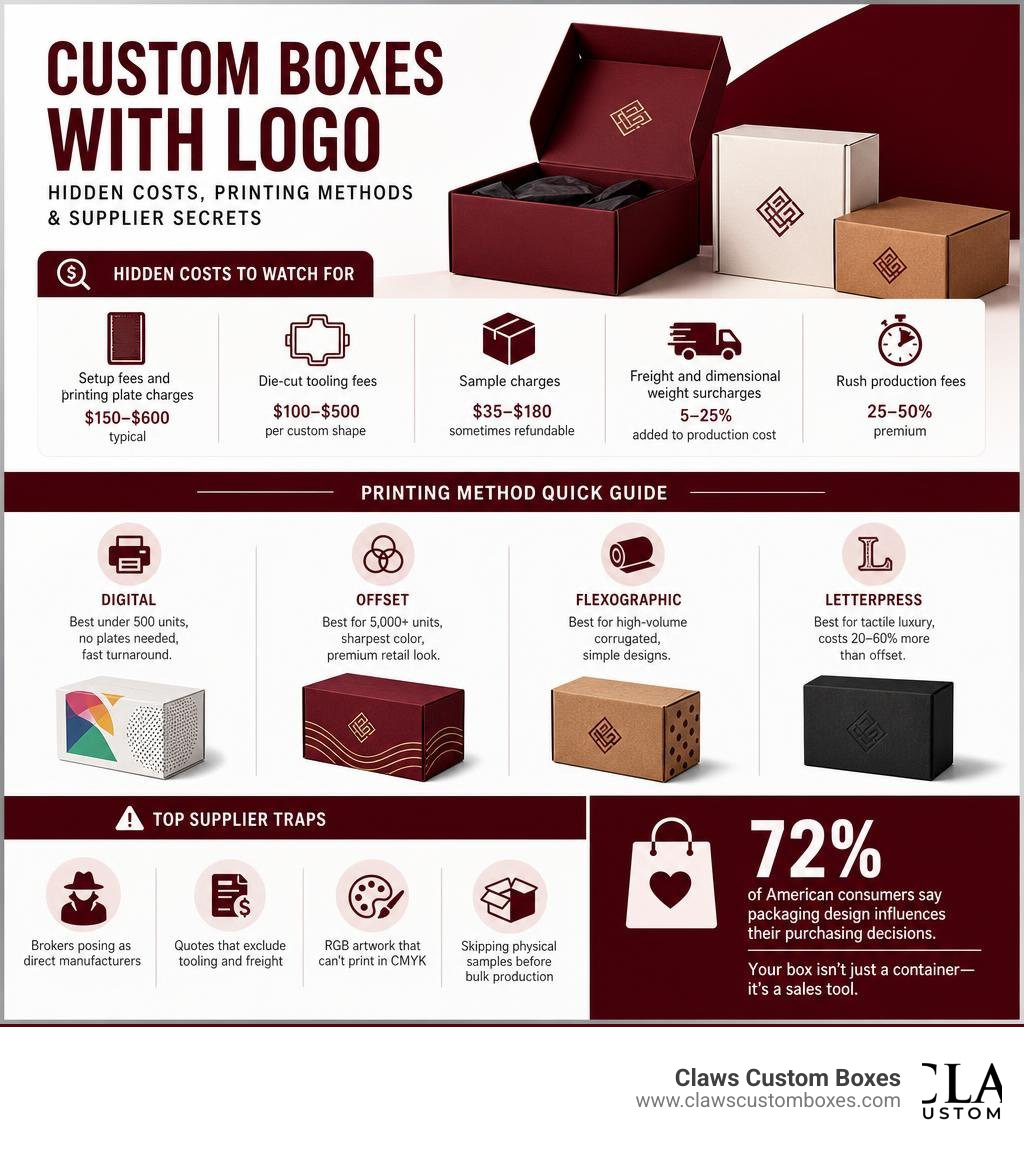
Hidden costs to watch for:
- Setup fees and printing plate charges ($150–$600 typical)
- Die-cut tooling fees ($100–$500 per custom shape)
- Sample charges ($35–$180, sometimes refundable)
- Freight and dimensional weight surcharges (adds 5–25% to production cost)
- Rush production fees (25–50% premium)
Printing method quick guide:
- Digital — best under 500 units, no plates needed, fast turnaround
- Offset — best for 5,000+ units, sharpest color, premium retail look
- Flexographic — best for high-volume corrugated, simple designs
- Letterpress — best for tactile luxury, costs 20–60% more than offset
Top supplier traps:
- Brokers posing as direct manufacturers
- Quotes that exclude tooling and freight
- RGB artwork that can’t print in CMYK
- Skipping physical samples before bulk production
And the stakes are real. Consider that 72% of American consumers say packaging design influences their purchasing decisions — meaning your box isn’t just a container, it’s a sales tool.
Yet most brands get their first quote, see the per-unit price, and assume that’s the full cost. It rarely is.
I’m Max Anderson, a packaging sourcing and link-building specialist who has spent years helping brands decode the real costs and supplier dynamics behind custom boxes with logo — including the hidden costs, printing methods, and supplier secrets that separate profitable packaging decisions from expensive ones. In the sections below, I’ll break down everything you need to know to order smarter.
Important Custom Boxes With Logo: Hidden Costs, Printing Methods & Supplier Secrets Most Brands Don’t Know terms:
- Custom Flip Top Boxes Wholesale with Logo
- Elite Custom Logo Rigid Boxes for Premium Credit Cards
- eco custom box manufacturer
Custom Boxes With Logo: Hidden Costs, Printing Methods & Supplier Secrets Most Brands Don’t Know

When you choose custom cardboard packaging over generic brown boxes, you are not just buying paperboard; you are investing in brand recognition, an unforgettable unboxing experience, and customer retention. Statistics show that the global custom packaging market is growing rapidly, expected to jump from USD 37.89 billion in 2024 to USD 59.62 billion by 2033. This growth is heavily driven by the e-commerce explosion.
However, many brands treat packaging as an afterthought, only to realize months down the road that their packaging is costing them 30% to 50% more than it should. To make custom packaging work for your bottom line, you must understand Custom Boxes and Their Strong Influence on Product Performance. A box that arrives crushed or features a misaligned, blurry logo can ruin your reputation and lead to costly returns.
If you are a business operating in Farmington, MI, or anywhere across the USA, local business resources like the Custom Boxes With Logo – Town Planner or regional event directories such as Custom Boxes with Logo – Farmington, MI – Caterer – Eventective can help you find regional commercial services. But regardless of where you are located, the fundamental rules of packaging physics and economics remain the exact same.
Budgeting for Custom Boxes With Logo: Hidden Costs, Printing Methods & Supplier Secrets Most Brands Don’t Know
When budgeting for custom boxes, you must look beyond the simple “price per unit.” The true cost of a packaging run is a combination of design, setup, material, printing, finishing, and logistics.
To avoid blowing your budget, it is critical to understand How Much Does Custom Packaging Cost? and what factors drive those numbers. For example, a basic folding carton might cost as little as $0.25 to $1.50 in high volumes, while a complex rigid box can easily cost $3.00 to $12.00+ per unit. If you do not account for setup fees, custom die-cut tooling, printing plates, and physical prototyping, you will face unexpected invoices that ruin your margins.
Vetting Suppliers for Custom Boxes With Logo: Hidden Costs, Printing Methods & Supplier Secrets Most Brands Don’t Know
Not all packaging suppliers are created equal. The market is saturated with brokers, trading companies, and direct manufacturers. Working directly with a manufacturer is almost always the best way to keep costs down and ensure quality control.
This is Why We Choose Best Printing Packaging Manufacturers who own their production facilities. A direct manufacturer can offer transparent pricing, lower defect rates, and direct communication with the engineering team. When you vet a supplier, ask for physical address verification, proof of quality control systems, and actual production floor photos to ensure you are not dealing with a middleman who marks up every single step of the process.
The Real Hidden Costs of Branded Packaging Beyond the Quote

The most common trap for growing brands is comparing quotes based solely on the unit price. A supplier might quote you a very low unit price, which sounds incredible until you receive the final invoice with an extra $1,500 tacked on for tooling, setup, and freight. To protect your business, you must study the 7 Mistakes to Avoid When Ordering Custom Boxes.
Let us shine a light on the specific hidden fees that frequently catch brands off guard:
- Setup and Prepress Fees: The cost of preparing digital files, aligning dielines, and calibrating the printing press.
- Storage and Warehouse Fees: If you order in bulk to get a discount but cannot store the boxes yourself, some suppliers will charge you monthly storage fees that erase your volume savings.
- Minimum Order Penalties: Buying below a supplier’s sweet spot can trigger low-volume surcharges.
Tooling, Plates, and Setup Fees
In traditional printing and manufacturing, physical tools must be created before a single box can be produced. For flexographic and offset printing, this means manufacturing metal or polymer printing plates. If your design has four colors, the supplier must make four separate plates, which can cost anywhere from $150 to $600.
Additionally, if your box is a custom size or shape, the manufacturer must build a custom steel-rule die to cut the cardboard. This die-cut tooling fee can run from $100 to $500+. Before choosing complex embellishments, review our Foil Stamping vs Spot UV Survival Guide to understand how specialized tooling and multiple passes through the press affect your setup fees.
Shipping, Freight, and Dimensional Weight (DIM) Pricing
Corrugated boxes are heavy and bulky. When shipping flat, unfolded boxes, freight can add 5% to 25% on top of your total production costs. But the real shock comes when you ship your finished products to your customers.
Carriers like USPS, FedEx, and UPS do not just charge by actual weight; they use a formula for Dimensional Weight (DIM):
$$\text{Dimensional Weight} = \frac{\text{Length} \times \text{Width} \times \text{Height}}{\text{Carrier Divisor}}$$
If your custom box is even 1/2 inch larger than necessary, you are paying to ship empty air. Right-sizing your packaging is the highest-return decision you can make. Trimming a box’s dimensions slightly can save thousands of dollars in monthly shipping bills while reducing the need for expensive void-fill materials.
Printing Methods Demystified: Digital, Offset, Flexo, and Letterpress
The printing method you choose directly dictates your upfront setup fees, your per-unit cost, and the final look of your logo. To make an informed decision, you must understand the different Printing Options available in the packaging industry today.
| Printing Method | Best Production Volume | Setup Cost | Print Quality | Best For |
|---|---|---|---|---|
| Digital | Low (1 to 500 units) | None | High (Great for gradients) | Startups, prototyping, seasonal runs |
| Offset Lithography | High (2,500+ units) | High ($500–$2,000) | Ultra-High (Sharpest detail) | Premium retail, cosmetics, electronics |
| Flexography | Very High (5,000+ units) | Medium ($150–$600) | Medium (Solid colors) | Corrugated shipping boxes, simple logos |
| Letterpress | Low to Medium (100–500) | High ($40–$150/plate) | Tactile & Premium (Debossed) | Luxury launches, high-end gift sets |
Digital Printing: Best for Low MOQs and Rapid Prototyping
Digital printing works like a giant, high-end version of your office inkjet printer. Because it prints directly from a digital file, there are absolutely no physical plates to buy. This eliminates setup fees and makes it the ideal choice for small businesses and startups.
Digital printing is perfect for runs under 500 units, allowing you to test the market or run seasonal packaging designs without financial risk. While the per-unit cost is higher compared to bulk offset printing, the zero-dollar setup fee makes it highly cost-effective for short runs.
Offset Lithography: The Gold Standard for Premium Retail
If you want your logo to look perfectly crisp with exact brand colors, offset lithography is the undisputed king. Offset printing transfers ink from metal plates onto a rubber blanket, which then presses the design onto the paperboard.
For a complete look at how this elevates your unboxing experience, see Custom Boxes With Logo: A Complete Branding Guide. Offset is highly efficient at scale; once the plates are paid for, the unit price drops dramatically for runs of 5,000 to 50,000+ units.
Flexography and Letterpress: High-Volume and Tactile Alternatives
Flexography uses flexible rubber plates to stamp ink onto corrugated board at incredible speeds. Modern flexo printers can run up to 600 meters of material per minute, making it the go-to method for standard shipping boxes with simple, one- or two-color logos.
Letterpress is a vintage technique that physically presses the design into the paperboard, leaving a beautiful, debossed tactile impression. Because it requires manual setup and specialty papers, letterpress typically costs 20% to 60% more than offset or digital printing, but it offers an unmatched premium feel for luxury brands.
Material Choices and Finishes: Balancing Cost, Durability, and Aesthetics
Your choice of material affects more than just the durability of your box; it acts as the canvas for your printed logo. To choose the right structure, you should explore different options in our Custom Boxes Style catalog to see how different box shapes and materials pair together.
Corrugated, SBS, and Kraft Paperboard
Selecting the right board grade keeps your products safe and prevents you from overpaying for heavy materials. Here is a quick breakdown of the most common materials:
- Corrugated Cardboard: The workhorse of e-commerce. It features a wavy fluting layer sandwiched between two liners. E-flute (1/16″ thick) is excellent for sleek retail mailers, while B-flute and C-flute are best for heavy shipping boxes.
- Solid Bleached Sulfate (SBS): A premium, bright white paperboard that is ideal for cosmetics, perfumes, and high-end retail cartons.
- Kraft Paperboard: The classic brown, eco-friendly choice. It is made from recycled fibers and is fully biodegradable, signaling natural and organic values to your customers.
To understand how these materials protect your products and build trust, read about Why Businesses Need Custom Boxes for Their Products.
Premium Finishes and Embellishments
Once your box is printed, you can apply specialty finishes to make your logo stand out. These finishes protect the ink from scuffing during shipping while adding a tactile element to the unboxing experience. For a comprehensive overview of your options, consult our Ultimate Checklist for Custom Packaging Boxes.
Popular finishes include:
- Spot UV: A glossy liquid coating applied only to your logo, creating a striking contrast against a matte background.
- Foil Stamping: Pressing metallic foil (gold, silver, or rose gold) into the paperboard for a brilliant shine.
- Soft-Touch Lamination: A micro-thin plastic film that gives the box a velvety, peach-fuzz texture.
Supplier Secrets and Common Traps to Avoid
The packaging industry is full of hidden traps that can delay your product launch or cost you thousands of dollars in reprints. By learning how manufacturers operate behind the scenes, you can protect your brand’s budget.
The Middleman Markup: Brokers vs. Direct Manufacturers
Many websites that look like packaging factories are actually brokers or trading companies. They take your order, add a 20% to 40% markup, and outsource the production to an actual factory. If something goes wrong with the printing, the broker will blame the factory, and you will be stuck in a endless loop of finger-pointing.
To find legitimate partners, consult our guide on Top Custom Packaging Suppliers Wholesale Manufacturers. Working directly with a real manufacturer ensures you get genuine wholesale pricing and clear accountability. To learn more about how wholesale supply chains function, see Custom Boxes Wholesale: All the Necessary Aspects That They Fulfill.
Artwork and Proofing Pitfalls
A beautiful design on a computer screen does not always translate perfectly to physical cardboard. To avoid blurry printing or cut-off text, you must follow a strict design workflow.
Always consult a professional Create Print Ready File Guide before submitting your artwork. Ensure your files are in vector format (AI, PDF, or EPS), convert all text to outlines, design in CMYK color mode rather than RGB, and include a 0.125-inch (3mm) bleed area beyond the dielines to prevent unprinted white edges.
Frequently Asked Questions About Custom Boxes With Logo
What is the typical minimum order quantity (MOQ) for custom boxes with a logo?
Minimum order quantities vary widely depending on the printing method. Digital printing allows for incredibly low MOQs—sometimes as low as 10 to 100 units. However, traditional offset and flexographic printing require MOQs of 500 to 1,000+ units to offset the high costs of setting up plates and tooling. For a complete list of what to evaluate before placing an order, check out What Things Are Important to Consider While Ordering Custom Boxes. You can also explore cost-effective strategies in this guide on Custom Boxes for Small Businesses Without Breaking the Budget.
How long does the production and delivery process usually take?
Standard production for custom packaging typically takes 10 to 15 business days after you approve your final digital artwork proof. If you are ordering a brand-new box structure or requesting premium finishes, first-time tooling can add an extra 5 to 7 days. For detailed timeline expectations, refer to What Is the Lead Time From Art Approval to Production Completion.
Can I get an exact color match for my brand logo on cardboard?
Yes, but it depends on the printing method and the material. Digital and CMYK printing use a mix of four inks, which can result in minor color variations (typically ±8 Pantone units). If you require an exact color match, you must use Pantone (PMS) spot colors, which use pre-mixed inks for perfect consistency. That printing on brown kraft paper will naturally mute colors, while white paperboard yields the brightest results. Be sure to submit your files in the correct Accepted File Formats to ensure color accuracy.
Conclusion
Navigating custom packaging does not have to be overwhelming. By understanding the true hidden costs, choosing the right printing methods, and working directly with a trusted manufacturer, you can create stunning branded boxes that protect your products and delight your customers without breaking the bank.
At Claws Custom Boxes, we manufacture high-quality, eco-friendly custom packaging boxes with logos at wholesale prices for businesses across the USA. Based in Farmington, MI, we offer tailored designs, 24/7 customer support, free shipping, and sustainable materials to ensure your packaging is a massive success. Ready to elevate your brand? Explore our options and design your own Custom Boxes With Logo today!
 ✦ Written byThe Claws Custom Boxes packaging teamStructural designers and print specialists helping brands get boxes right the first time.
Ask an expert
✦ Written byThe Claws Custom Boxes packaging teamStructural designers and print specialists helping brands get boxes right the first time.
Ask an expert