Why Packaging Mistakes Are Silently Draining Small Business Budgets
Custom packaging for small businesses — and the 17 costly packaging mistakes new brands make — is a topic that matters more than most founders realize until it’s too late.
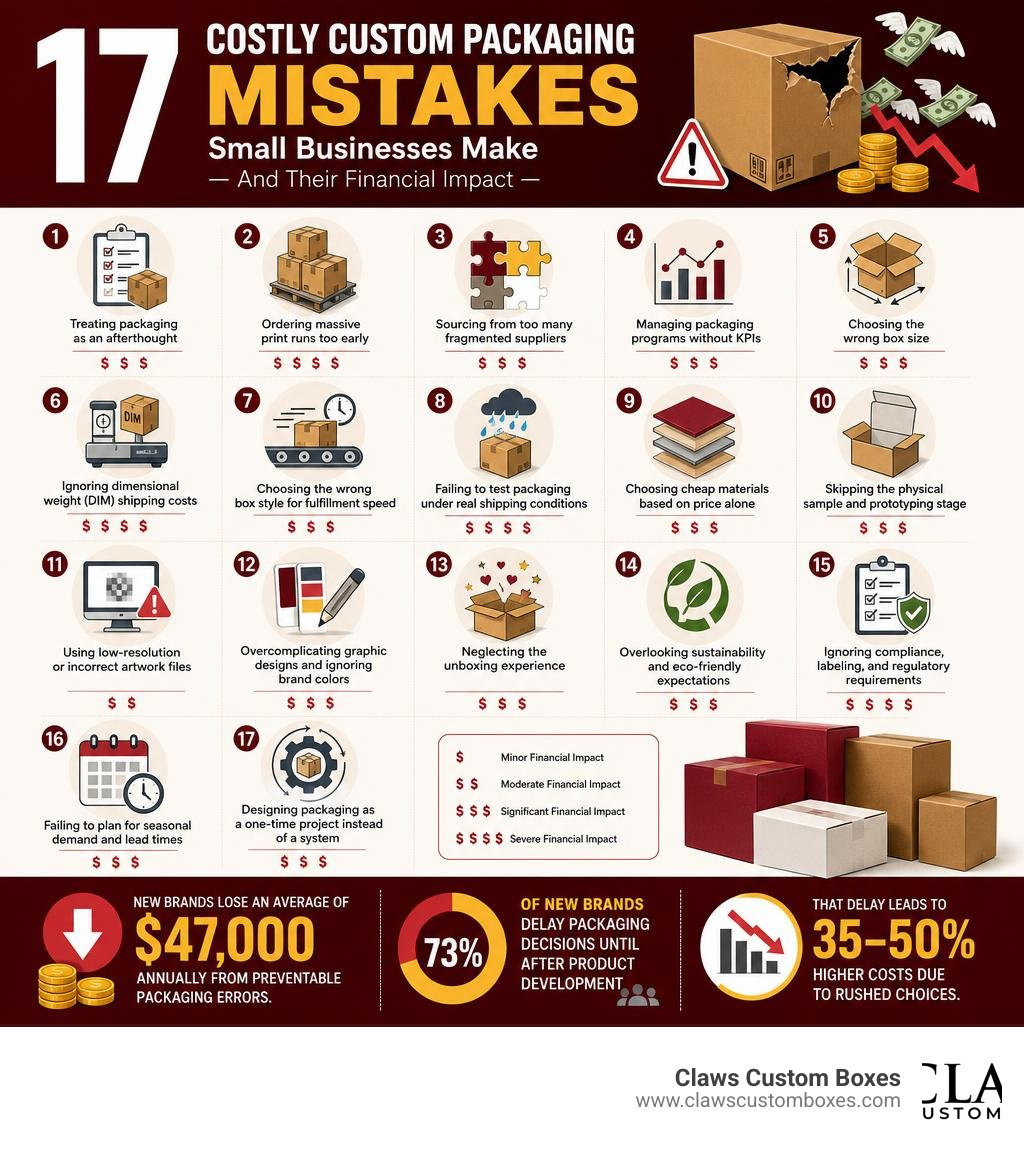
Here’s a quick summary of the 17 mistakes covered in this article:
- Treating packaging as an afterthought
- Ordering massive print runs too early
- Sourcing from too many fragmented suppliers
- Managing packaging programs without KPIs
- Choosing the wrong box size
- Ignoring dimensional weight (DIM) shipping costs
- Choosing the wrong box style for fulfillment speed
- Failing to test packaging under real shipping conditions
- Choosing cheap materials based on price alone
- Skipping the physical sample and prototyping stage
- Using low-resolution or incorrect artwork files
- Overcomplicating graphic designs and ignoring brand colors
- Neglecting the unboxing experience
- Overlooking sustainability and eco-friendly expectations
- Ignoring compliance, labeling, and regulatory requirements
- Failing to plan for seasonal demand and lead times
- Designing packaging as a one-time project instead of a system
Most new brands treat packaging as the last box to check — something to figure out once the product is ready. That’s a costly mistake.
Research shows new brands lose an average of $47,000 annually from preventable packaging errors. And 73% of new brands delay packaging decisions until after product development, which forces rushed choices that increase costs by 35–50%.
The damage isn’t always obvious at first. It shows up quietly — in rising shipping bills, customer complaints, damaged products, and repeat purchases that never come. As one industry observer put it, packaging rarely fails in a controlled environment. It fails in the supply chain.
The good news? Every single one of these mistakes is avoidable with the right knowledge upfront.
I’m Max Anderson, a backlink builder and content strategist with hands-on experience researching the operational and branding challenges behind custom packaging for small businesses and the 17 costly mistakes new brands make. In this guide, I’ve pulled together the most important insights so you can protect your budget and build a packaging strategy that actually works.
Discover more about Custom Packaging for Small Businesses: 17 Costly Packaging Mistakes New Brands Make (And How to Avoid Them):
- How to Save Money on Wholesale Candle Packaging
- Why Small Businesses Need Custom Packaging to complete in 2026
- Why Small Businesses Prefer Custom Tuck Boxes
Custom Packaging for Small Businesses: 17 Costly Packaging Mistakes New Brands Make (And How to Avoid Them)
When launching a new brand in June 2026, the excitement of getting your products to market can easily overshadow the logistics of how those products travel. However, ignoring the realities of physical distribution is a fast track to financial loss. For a startup operating on a lean startup budget, every dollar counts.
Investing in custom packaging is no longer a luxury reserved for multi-million-dollar corporations. In fact, understanding Custom Packaging to Complete in 2026 is the first step toward building a sustainable, profitable business model. Yet, many emerging brands find themselves falling victim to Common Packaging Mistakes, turning what should be a powerful brand asset into a major financial drain.
The Real Cost of Custom Packaging for Small Businesses: 17 Costly Packaging Mistakes New Brands Make (And How to Avoid Them)
The financial impact of poor packaging decisions is staggering. New brands lose an average annual loss of $47,000 due to preventable packaging mistakes. Beyond the daily trickle of wasted materials and elevated shipping rates, the ultimate worst-case scenario looms: product recalls. The Consumer Product Safety Commission recalls approximately 400 products every year, with each recall costing an average of $10 million.
While your small business may not face a multi-million-dollar recall, a single batch of damaged goods can completely destroy your early profit margins and ruin your reputation. Reviewing the 7 Mistakes to Avoid When Ordering Custom Boxes before you place your first order is essential to safeguarding your brand’s future.
Mistake 1: Treating Packaging as an Afterthought
One of the most common mistakes new brands make is treating packaging as a finishing touch rather than an integrated component of product development. When packaging decisions are delayed until the last minute, brands are forced into rushed choices.
This lack of planning leads to emergency packaging orders, which often carry a 50% to 100% price premium due to expedited production and air freight shipping. To avoid these unnecessary expenses, it is critical to understand Custom Packaging Cost early in your product development phase so you can budget accurately and avoid last-minute panic.
Mistake 2: Ordering Massive Print Runs Too Early
It is tempting to place a massive order of 10,000+ custom boxes right out of the gate to secure the lowest possible price per unit. However, 86% of startups that do this before achieving consistent sales traction end up with $25,000 to $75,000 in obsolete inventory.
Your product dimensions, branding, or regulatory requirements will almost certainly change during your first year of business. Instead of tying up your precious working capital in stacks of unusable cardboard, look into 4 Ways Wholesale Custom Packaging Boxes by leveraging flexible ordering strategies and manageable minimum order quantities (MOQs).
Mistake 3: Sourcing From Too Many Fragmented Suppliers
When you buy your shipping boxes from one vendor, your custom tissue paper from another, your branded stickers from a third, and your product inserts from a fourth, you are setting yourself up for supply chain chaos.
Fragmented sourcing inevitably leads to brand drift — where your brand colors look slightly different on every piece of packaging — and severe quality inconsistency. Consolidating your packaging needs under a single, reliable manufacturer ensures that all elements of your presentation match perfectly. To understand how to streamline this process, explore Custom Boxes Wholesale to keep your branding unified and professional.
Mistake 4: Managing Packaging Programs Without KPIs
If you cannot measure it, you cannot optimize it. Many emerging brands manage their packaging intuitively rather than tracking hard numbers. Without clear Key Performance Indicators (KPIs), you will remain blind to the quiet leakages in your budget.
Every small business should actively track:
- Transit damage rate: How often do products arrive broken?
- Return rate due to packaging issues: Are customers returning items because of poor presentation or structural failure?
- Dimensional weight variance: Are you regularly paying more for shipping space than your product actually requires?
Structural, Material, and Printing Mistakes That Hurt Brand Performance

When packaging fails physically, the aesthetic design no longer matters. If a customer receives a crushed box with a broken item inside, their relationship with your brand is instantly damaged. According to research on Top Common Packaging, structural integrity and print quality are the absolute foundation of successful product delivery. Let’s look at the functional design errors highlighted in 5 Common Packaging Mistakes and how to prevent them.
Mistake 5: Choosing the Wrong Box Size
Getting the box size wrong is an incredibly common error that works against you in both directions:
- Oversized boxes: If your box is too large, your product will slide around during transit, requiring excessive void fill (like bubble wrap or packing peanuts) and raising your shipping costs.
- Undersized boxes: If your box is too small, your fulfillment team will struggle to pack items quickly, and the lack of clearance will leave your product vulnerable to impact damage.
For many small retail items, learning Why Small Businesses Prefer Custom Tuck Boxes can be a game-changer, as these boxes provide a snug, highly secure fit that minimizes movement without requiring excess material.
Mistake 6: Ignoring Dimensional Weight (DIM Weight) Shipping Costs
Major shipping carriers like FedEx, UPS, and USPS do not just charge you based on how much your package weighs; they charge you based on how much space it occupies in their trucks. This is called Dimensional Weight (DIM Weight) pricing.
Carriers calculate this using specific formulas:
$$\text{Dimensional Weight (lbs)} = \frac{\text{Length} \times \text{Width} \times \text{Height}}{\text{Carrier Divisor}}$$
The standard carrier divisor is 139 for FedEx and UPS, and 166 for USPS.
If you ship a lightweight item in an oversized box, you will be billed at the higher dimensional weight rather than the actual physical weight. Right-sizing your boxes to eliminate empty space can instantly slash your shipping fees by 10% to 20%.
Mistake 7: Choosing the Wrong Box Style for Fulfillment Speed
Your packaging does not just exist for the customer; it also has to work for your fulfillment team. Choosing an overly complex box style can severely slow down your pack-line speed and drive up your operational labor costs.
For example, a classic Regular Slotted Carton (RSC) is highly reliable but requires packing tape on both the top and bottom. On the other hand, a custom mailer box with self-sealing adhesive strips can be assembled and sealed in seconds. Review Custom Printed Retail Packaging to find a box style that balances beautiful presentation with lightning-fast fulfillment.
Mistake 8: Failing to Test Packaging Under Real Shipping Conditions
Never assume your packaging is ready for the real world just because a physical prototype looks great on your desk. Only 31% of new brands test their packaging under real shipping conditions before launch.
Skipping this step leads to average damage rates of 8% to 15% during shipping. In contrast, brands that perform drop testing (dropping a fully packed box from a height of 6 feet onto various angles) and shipping simulations enjoy damage rates of just 2% to 4%.
Mistake 9: Choosing Cheap Materials Based on Price Alone
When looking at unit prices, it is incredibly tempting to choose the thinnest, cheapest cardboard available. However, cheap materials are a classic false economy.
Low-grade cardboards easily absorb moisture, lose their structural integrity when stacked in cold warehouses, and arrive at your customer’s doorstep looking crushed and beaten. These material failures increase your total landed cost by 45% to 60% due to returns, product replacements, and brand reputation damage. To avoid looking cheap while staying on budget, read up on how to design Budget Friendly Logo Boxes.
Mistake 10: Skipping the Physical Sample and Prototyping Stage
With modern digital 3D modeling, it is tempting to approve your design on a computer screen and jump straight into bulk production. This is a massive gamble. A digital rendering cannot show you how a specific paper weight feels in your hands, how securely the tabs lock together, or how your product actually fits inside.
Always request a physical 3D sample and a pre-press proof from your manufacturer. Follow the Ultimate Checklist for Custom Packaging Boxes to ensure your prototype meets every single functional and visual requirement before committing to a full production run.
Mistake 11: Using Low-Resolution or Incorrect Artwork Files
There is nothing more disappointing than opening a fresh shipment of custom boxes only to find that your logo is blurry, pixelated, or the wrong color. This almost always happens because of improper artwork preparation.
To ensure crisp, professional print quality, always follow these rules:
- Resolution: All raster images must be at least 300 DPI (Dots Per Inch). Never use low-resolution 72 DPI web graphics.
- Format: Submit your artwork in vector format (AI, EPS, or PDF) with all fonts outlined.
- Color Mode: Design your files in CMYK color mode rather than RGB (which is only meant for digital screens).
- Dielines: Keep your artwork perfectly aligned with the manufacturer’s official dieline template.
Mistake 12: Overcomplicating Graphic Designs and Ignoring Brand Colors
When new brands get access to custom printing, they often try to cram too much onto the box — cluttered patterns, multiple fonts, and excessive blocks of text. This visual clutter dilutes your brand identity and makes your packaging look unprofessional.
Furthermore, ignoring color consistency can lead to a messy brand presentation. Utilizing Pantone matching ensures your signature brand colors look identical across every run. Keep your design clean, intentional, and focused on your core elements. For inspiration, check out these Tips to Follow on How to Create Unique and Limitless Custom Boxes.
Customer Experience, Compliance, and Strategic Solutions

In today’s highly competitive e-commerce landscape, your packaging is much more than a simple shipping container — it is a vital marketing channel. As highlighted in Packaging Mistakes New Businesses Make (and How to Avoid Them), your packaging is the very first physical touchpoint your customer has with your brand. Let’s look at how to optimize this crucial moment for maximum customer loyalty and seamless regulatory compliance.
Mistake 13: Neglecting the Unboxing Experience
Have you ever tried to open a package only to find yourself struggling with layers of plastic tape, hard-to-tear cardboard, and tightly bound shrink-wrap? This frustrating phenomenon is known as “wrap rage,” and it is an incredibly quick way to alienate your customers.
On the flip side, 52% of customers are highly likely to buy again from an online retailer if their order arrives in premium, thoughtful packaging. Elevating the unboxing experience does not have to cost fortune. Simple additions like custom tissue paper, branded stickers, or a personalized thank-you note can make your delivery feel like a special gift. Read more about How Packaging Can Take Your Business to the Next Level by turning a basic delivery into a highly shareable social media moment.
Mistake 14: Overlooking Sustainability and Eco-Friendly Expectations
Modern consumers are incredibly environmentally conscious. In fact, 78% of consumers consider environmental impact when making a purchase decision, and 82% are willing to pay more for sustainable packaging (including a massive 90% of Gen-Z consumers).
If your brand uses non-recyclable plastics, oversized boxes, or excessive plastic void fill, you will likely face customer backlash. Switching to FSC-certified, fully recyclable paper materials and biodegradable void fill is a highly effective way to win customer trust. Learn more about Why Businesses Need Custom Boxes for Their Products to align your brand with these growing green consumer expectations.
Mistake 15: Ignoring Compliance, Labeling, and Regulatory Requirements
Skipping compliance and labeling research is one of the most dangerous and expensive mistakes a new brand can make. Depending on your industry and product category, you may be legally required to print specific information directly on your packaging.
This includes:
- FDA labeling: Nutritional facts, ingredient lists, and allergen warnings for food and cosmetics.
- Prop 65 warnings: Required chemical disclosures for products sold in California.
- Country of Origin: Clear marking of where the product was manufactured.
Failing to meet these strict requirements can lead to heavy government fines, forced product recalls, or even lawsuits. Always audit your packaging compliance requirements before printing.
Mistake 16: Failing to Plan for Seasonal Demand and Lead Times
Many new brands are caught completely off guard by the realities of packaging supply chains. Standard custom packaging lead times are typically 6 to 8 weeks, but this can easily stretch to 10 to 12 weeks during the peak holiday season (September through November) due to paper mill and shipping bottlenecks.
If you wait until October to order your holiday packaging, you will either face massive rush fees (often 30% to 50% extra) or completely miss the holiday sales window. Plan your packaging calendar well in advance, and place your holiday orders by late July or early August to lock in standard pricing.
Mistake 17: Designing Packaging as a One-Time Project Instead of a System
Your packaging strategy should never be static. As your business grows, your product lines will expand, your distribution channels will shift, and your fulfillment processes will become more automated.
If you design your packaging as a rigid, one-time project, you will struggle to scale efficiently. Instead, build a flexible packaging system that can easily adapt to different product lifecycles and sizes. To understand how dynamic packaging design directly impacts long-term business growth, explore Custom Boxes and Their Strong Influence on Product Performance.
Action Plan: Overcoming Custom Packaging for Small Businesses: 17 Costly Packaging Mistakes New Brands Make (And How to Avoid Them)
To help you choose the absolute best path forward for your business, here is a quick comparison of the two main printing technologies used in custom packaging:
| Feature | Digital Printing | Flexographic Printing |
|---|---|---|
| Best For | Low volumes, prototyping, and seasonal runs | High-volume production and long-term consistency |
| Minimum Order Quantity (MOQ) | Very low (often starting at 25–100 units) | High (typically 1,000–5,000+ units) |
| Setup Cost | Extremely low (no physical print plates required) | High (requires custom physical plates) |
| Lead Time | Fast (typically 1–2 weeks) | Moderate (typically 3–5 weeks) |
| Unit Cost at Scale | Higher per-unit cost | Extremely low per-unit cost |
If you are looking for highly creative, budget-friendly ways to get started, review these Small Business Packaging Ideas. For a deeper dive into managing your early startup expenses, watch this helpful video on Custom Packaging For Small Business – YouTube.
Frequently Asked Questions about Custom Packaging Mistakes
What is the most common custom packaging mistake small businesses make?
The single most common and costly packaging mistake is choosing the wrong box size. Oversized boxes significantly inflate your dimensional weight (DIM weight) shipping fees, waste packing materials, and leave your products vulnerable to damage during transit. Right-sizing your boxes to snugly fit your products can reduce your overall shipping expenses by 10% to 20%.
How do I know if my packaging artwork is print-ready?
Your packaging artwork is considered print-ready when it is designed in vector format (AI, EPS, or PDF) with all fonts outlined, all raster images set to a minimum of 300 DPI, and the color profile set to CMYK mode. It must also perfectly align with your manufacturer’s official dieline template, including proper bleed lines.
How far in advance should I order custom packaging?
Under normal conditions, you should allow at least 6 to 8 weeks for custom packaging production and delivery. However, during the peak holiday season (September through November), lead times can easily stretch to 10 to 12 weeks. It is best to place your holiday packaging orders by late July or early August to avoid expensive rush fees.
Conclusion
Avoiding these 17 costly packaging mistakes is one of the smartest ways to protect your startup budget, streamline your operations, and build a highly professional brand presence. Your packaging is much more than a simple box — it is a powerful tool to protect your products, delight your customers, and grow your bottom line.
At Claws Custom Boxes, based in Farmington MI, Michigan USA, we specialize in manufacturing high-quality, eco-friendly custom packaging boxes with logos at competitive wholesale prices. We are proud to support small businesses across the USA with tailored designs, 24/7 support, free shipping, and premium sustainable materials.
Ready to design packaging that protects your products and elevates your brand? Get Custom Boxes Wholesale today and work with a team dedicated to your business’s long-term success!
 ✦ Written byThe Claws Custom Boxes packaging teamStructural designers and print specialists helping brands get boxes right the first time.
Ask an expert
✦ Written byThe Claws Custom Boxes packaging teamStructural designers and print specialists helping brands get boxes right the first time.
Ask an expert